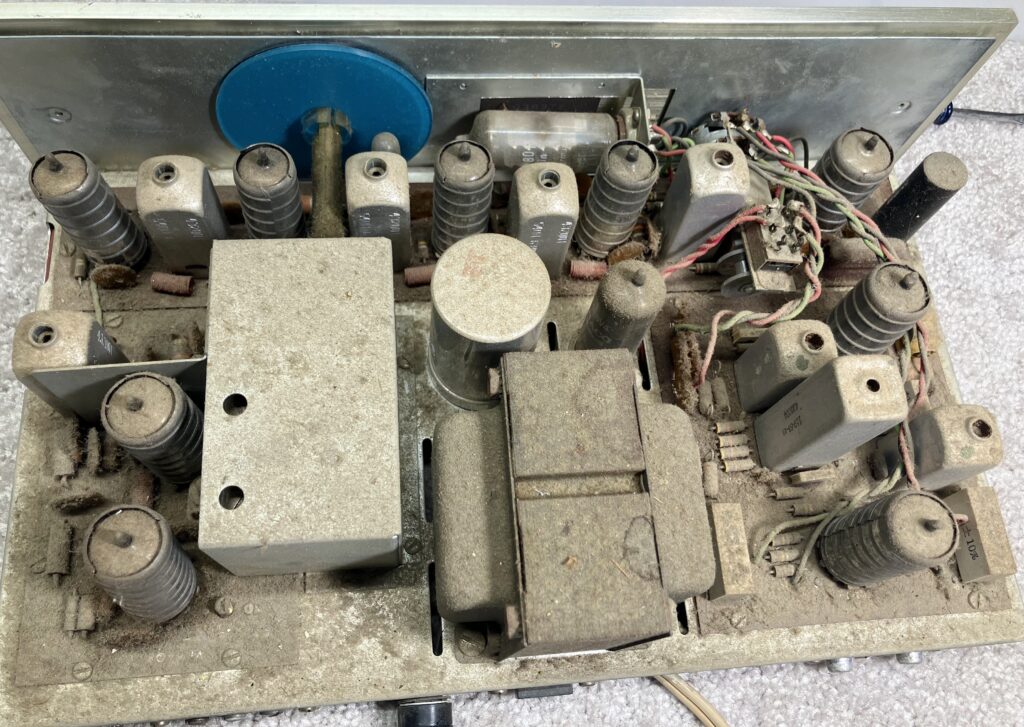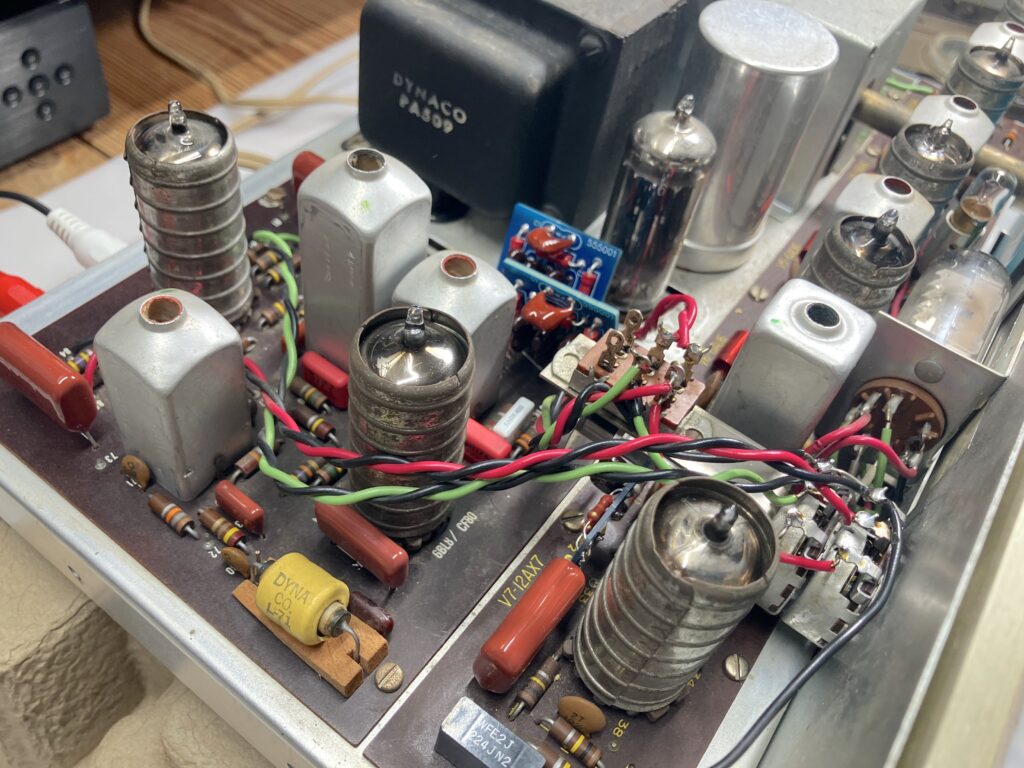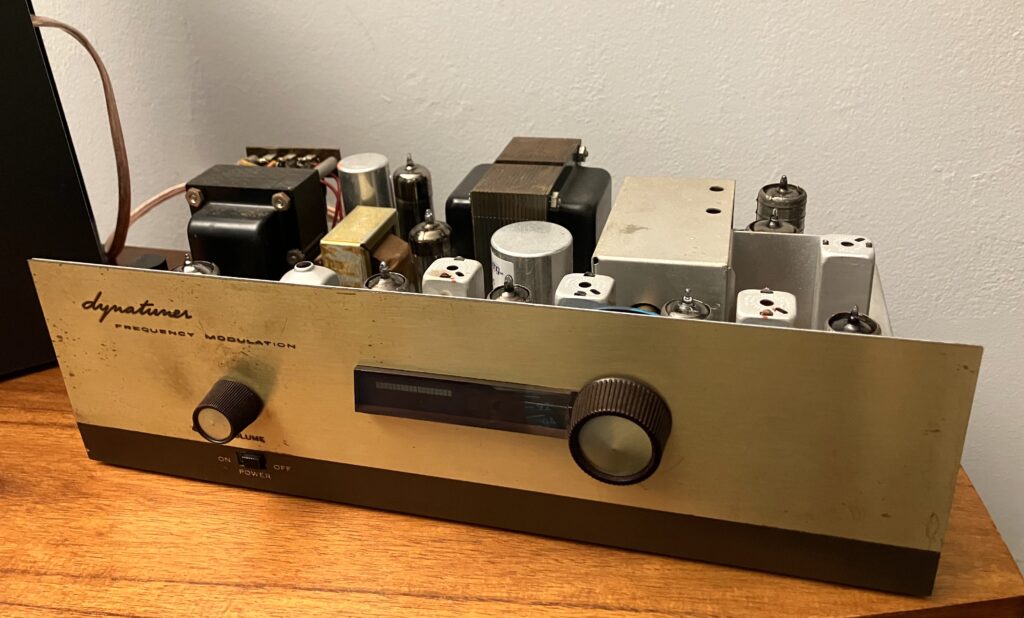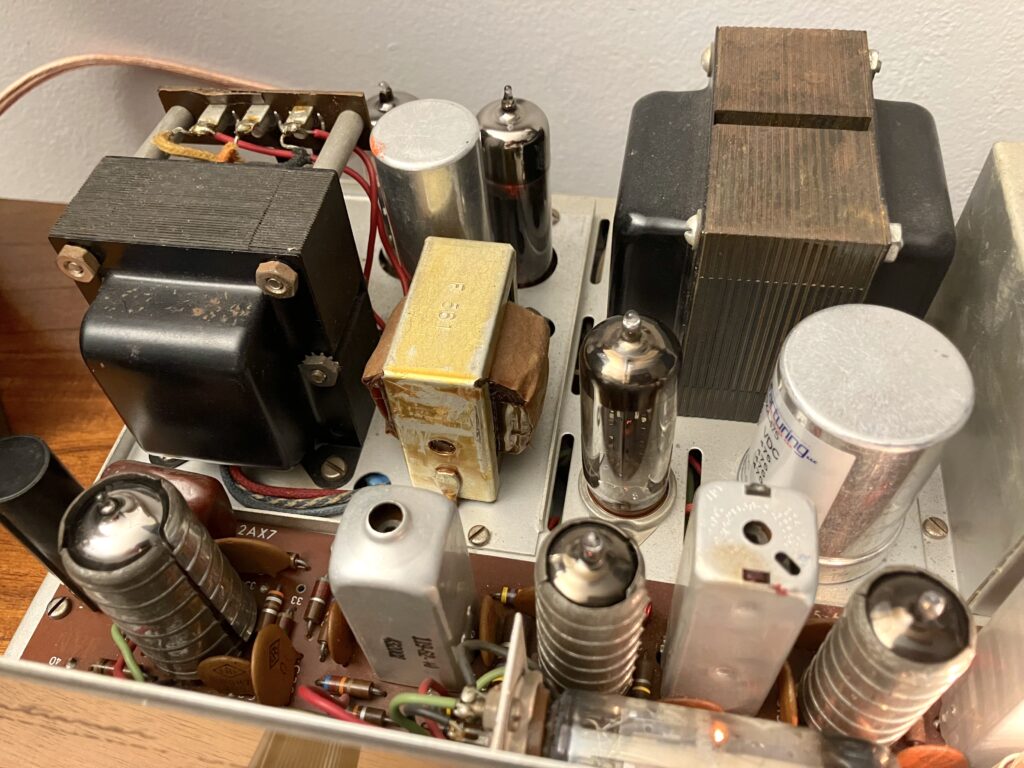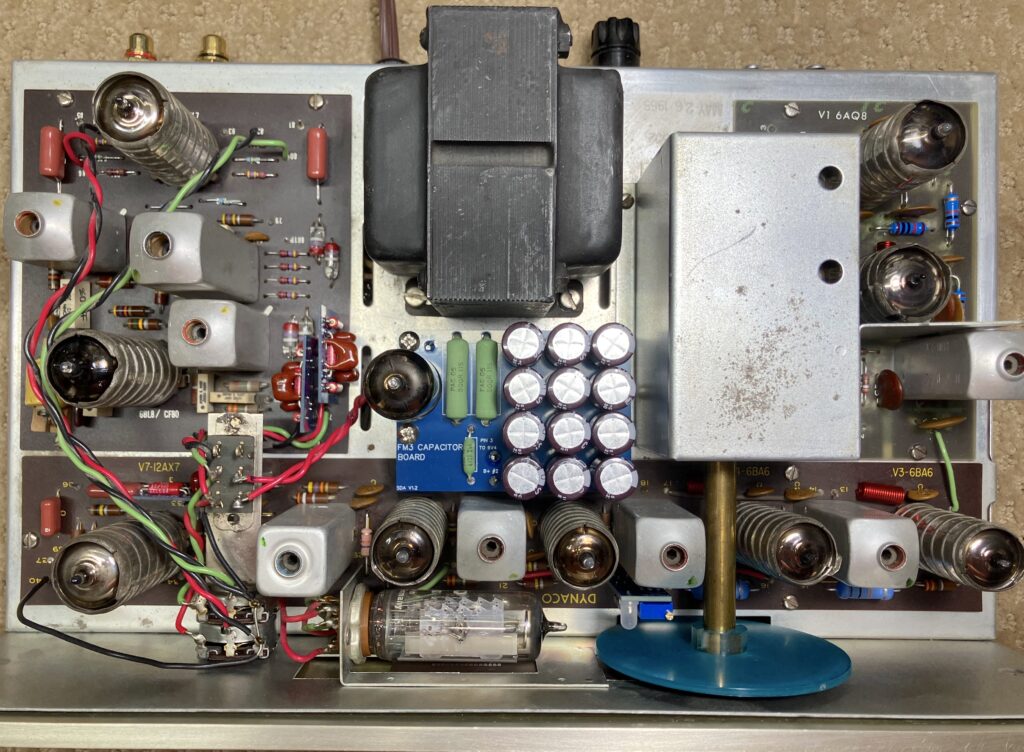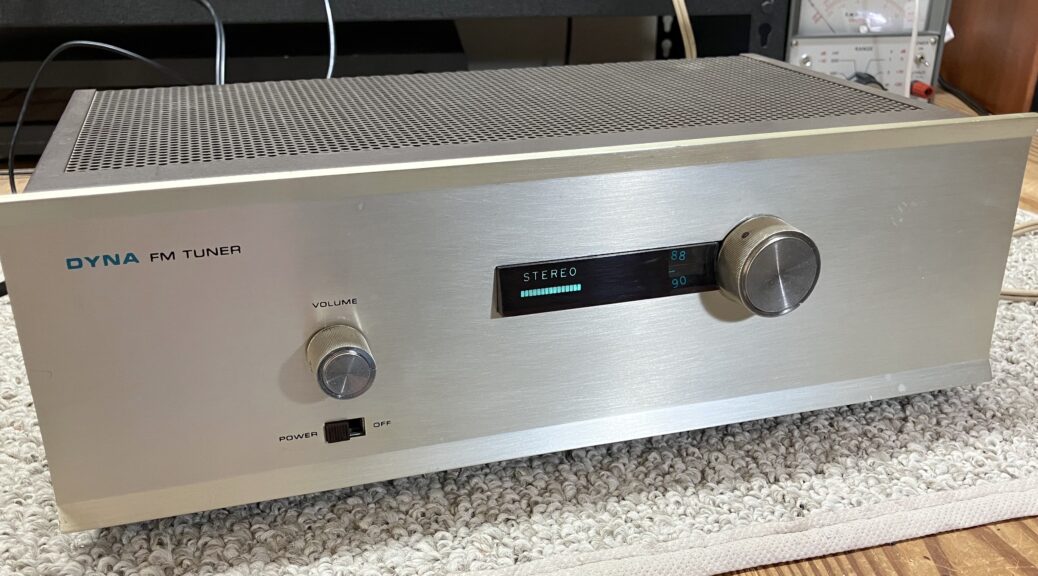
While it has a plain-Jane appearance and is perhaps lacking some convenience features like a bandwidth switch or muting, this tuner that came out in 1964–when tweaked like we know how–sounds surprisingly good, better than it should. It’s slightly warm and provokes no listener fatigue. You can get caught up in the music for hours.
After restoring several FM-3 stereo tuners for ourselves and friends while learning and noting all the tips and tricks, we decided to offer the service to anyone. (We’ll work on the mono FM-1, too. Please inquire.)
There are thousands of units out there, and many would benefit from a basic tuneup, others a complete restoration. While this tuner was designed to be aligned without any special equipment (other than optionally a VTVM), there’s no rule against it, and we get better results– especially on the IF stages and front end adjustments. We use a Leader 3236 synthesized AM/FM stereo signal generator, a restored Eico 249 VTVM, and a QuantAsylum QA403 audio analyzer. The IF alignment is standard (not swept). For parts, we use top-quality audio-grade capacitors and resistors from Nichicon, Panasonic, Wima, TDK, and Vishay.
We offer several options. You can choose any you want. That said, Option A usually is the best place to start, with Option B a perfect and natural complement.
Option A $149
Inspection, current draw and voltage checks, tube testing and replacement (if required), complete alignment (IF, discriminator, front end, multiplex board), switch cleaning. Includes one-hour run-in. (We also do a check for bad resistors and replace any found.)
In many cases, unless yours has a bad hum or is otherwise noisy, this option gets your FM-3 running well and sounding good. Tubes replaced, if required, at modest extra cost.
Don’t ignore your tubes! They’re all important, but the 6AT8A and 6BL8 tubes are notoriously flaky, and if they aren’t working right, your tuner certainly isn’t working right. Ideally, the audio out tube V72A (12AX7) triodes should be balanced to 20% or better.
Alignment only: If you’re confident in your tubes and want a full alignment only, that’s $99. That adjusts the IF section, discriminator, front end, and stereo multiplex board.
Why Have a Tech Align a Tuner Designed for User Alignment? Yes, the FM-3 was designed to be user-aligned with no or minimal instruments, and that generally worked well back in the day when the FM dial was sparsely populated and still had some mono stations, but a precise and expensive modern FM stereo signal generator like ours produces far more accurate results under modern conditions. For aligning the IF stages, the Dynaco method requires you to find a quiet area between stations, which can be a challenge depending on your location. Dynaco also calls for a mono station for aligning the discriminator and weak signals for much of the front end adjustments (which directly affect sensitivity). Again, nearly impossible to find. And, IF transformers T2-T4 slave off T1 for the IF stages alignment with the Dynaco method. How would you know if your T1 is set at 10.7 MHz in the first place? Lots of them have been “tweaked” over the years. That would throw off the entire IF alignment.
Our alignment procedure neutralizes all these challenges.
Your FM-3 will find more stations, with higher fidelity and better stereo separation.
Stereo Separation Test: For an additional $19 we’ll perform an IEEE/IHF stereo separation test at 1,000 Hz. This is done at the end of the alignment, right after the MPX board adjustments. You’ll get all the test results details.
Discriminator Set to Lowest THD: For an additional $19 we’ll use our QuantAsylum QA403 audio analyzer to adjust the discriminator to lowest distortion. Typically, the standard VTVM method achieves about 0.70%-0.90% THD. Tweaking with the QA403 usually gets it down to around 0.40%-0.48%. Plus, the signal-to-noise ratio will be somewhat better, usually above the 70-dB Dynaco spec. Otherwise, we’ll use the standard Dynaco VTVM method to set your discriminator.
The following options are priced separately from Option A, which is strongly recommended after completion of any option below:
Option B $159
Replacement of the four-section electrolytic filter capacitor can and two key film caps (C29, C31) and resistor upgrade (R2 and R3 to 2W metal oxide, R11 and R13 to 3W metal oxide, R38 to metal oxide). Your FM-3 will run cooler and quieter.
The original four-section electrolytic filter capacitor can is ancient and probably humming and near failure. R38 is at the original value but replaced with a quieter metal oxide type. The other four resistors are at their original resistance values but replaced with quieter metal oxides at higher wattage ratings, as the originals often get hot and scorch the circuit board.
C29 and C31 are replaced with fresh audio-grade polypropylene caps.
Option C $69
Replacement of all eight stereo multiplex board film capacitors with top-shelf audio-grade polypropylene capacitors. This option results in lower noise in stereo and better stereo separation. AC coupling capacitors C82 and C83 are increased a bit from 0.1 µF to 0.47 µF for compatibility with modern amplifiers and a flatter low-bass response. This allows your tuner to be used with older tube preamplifiers with an input impedance of around 470 kΩ and modern preamplifiers that are nearer to 50kΩ, and maintain a flat frequency response in the low bass region. (We’re purists and don’t consider changing the values of C82 and C83 a modification as much as an adjustment.)
Option D $99
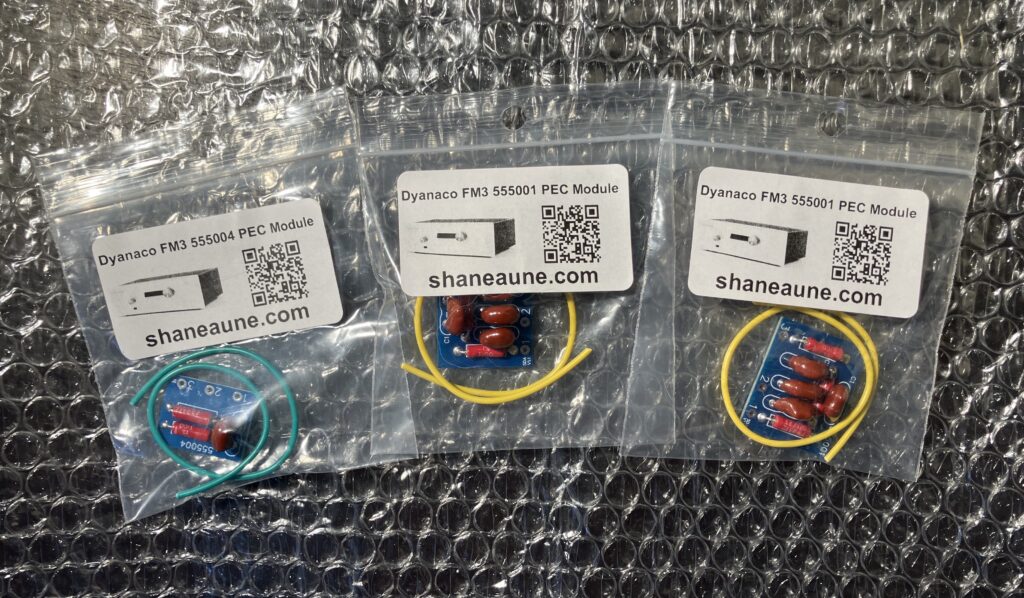
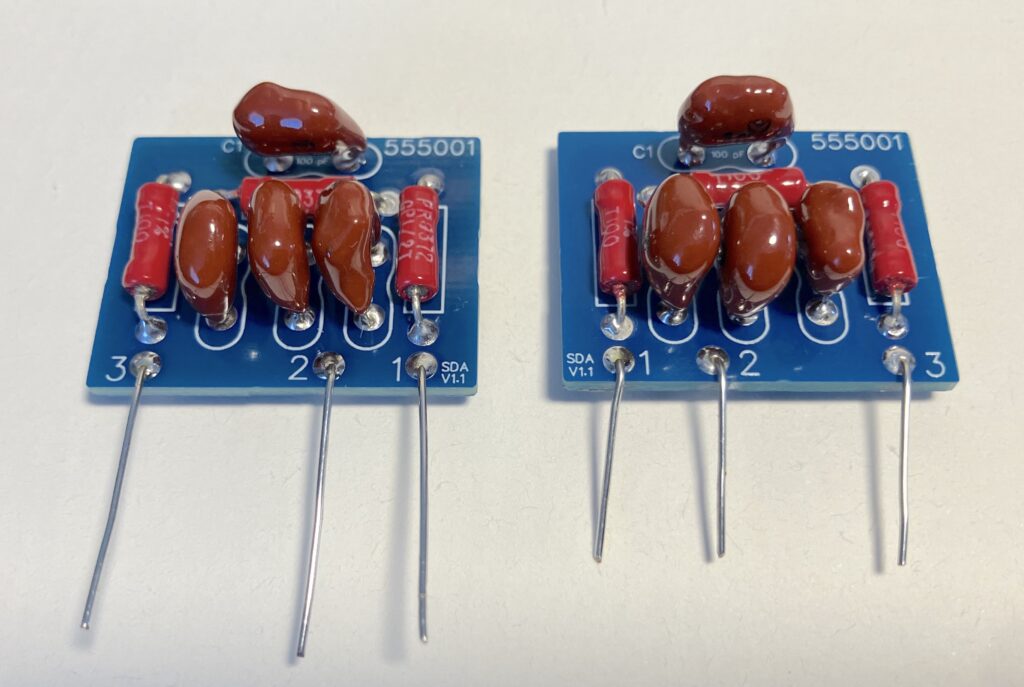
Replacement of PEC-1 and PEC-2 (Dynaco part 555001) and the PC-8 PEC (Dynaco part 555004). The PEC-1 and 2 replacement corrects a design error in the de-emphasis circuit that depresses the upper frequencies. With this option you’ll get a more neutral tonal balance because of the resulting flatter frequency response between about 10 kHz to 15 kHz. Again, not a modification–more a correction. We didn’t invent it. It’s been around now for years. We also replace the PC-8 PEC module, which is less audibly critical than the other PEC modules, but it’s getting old, and it’s a good idea to replace it while we’re already in there. The main parts used are expensive, close-tolerance mica capacitors, and building the boards is time-intensive, so this option is somewhat costly.
How to Send Your Unit
Shipping an FM-3 is simple and inexpensive by ground. It’s fairly small and light, nothing like a typical AM/FM stereo receiver. See packing details below.
Go to the Dynaco FM-3 Services Order Form tab on the home page, print out the form, and send it with your tuner. Please make sure to review the options carefully in the section above. Feel free to email at any time if you have questions.
Some Details to Keep in Mind
While we keep some spare Dynaco FM-3 parts around and can do basic troubleshooting, this service is intended for tuners that will power up or were working in the past and put up in the closet or down in the basement. We do have spare knobs, faceplates, covers, tubes, and even some power transformers. If in doubt, please contact us before sending.
Unrestored FM-3s are available commonly in working condition with all the tubes for about $80-$120 on the Web, far less at garage sales. Go for a factory-wired unit if possible, which has rivet fasteners on the back panel and normally a silver serial number sticker back there, too, that says “Factory Wired”.
Packing
No need to remove tubes or tube shields. The best way to pack is to wrap the entire unit in a clean soft cloth or place it in a clean plastic bag and then wrap it in bubble wrap and then place the wrapped tuner in a box, filling up the gaps on all sides and top and bottom with wadded newspaper or wrapping paper, and tape it shut. Coil the power cord loosely and put a rubber band around it, and tuck the cord out of the way near the chassis back. Some extra bubble wrap or padding on the front panel side is a good idea, too. Then, place that box into a larger box (minimum 2″ larger on all sides) with wadded newsprint, bubble wrap or other padding all around–top, sides, and bottom–for cushioning, and tape it shut. Everything should be snug, but not super-tight.
Payment
We accept Zelle (preferred) or PayPal, but we can accept personal checks.
Warranty
Our parts and labor are warranted for 30 days. If something comes up within 30 days, contact us with a description of the problem. If additional work is required, owner is responsible for return shipping. We’ll cover shipping back to you.
Turn-Around Time
We can usually complete your FM-3 in about four days after it arrives.
Notable FM-1s and FM-3s We’ve Worked On Recently